The AI Engineering Loop
Building with LLMs is not a one-way delivery process. A system can be technically healthy and still fail on output quality, cost, latency, or consistency once it meets real users.
That is why AI engineering needs a loop. Teams need a way to observe real behavior, identify failure modes, turn those findings into test cases, compare improvements, and decide what is actually worth shipping.
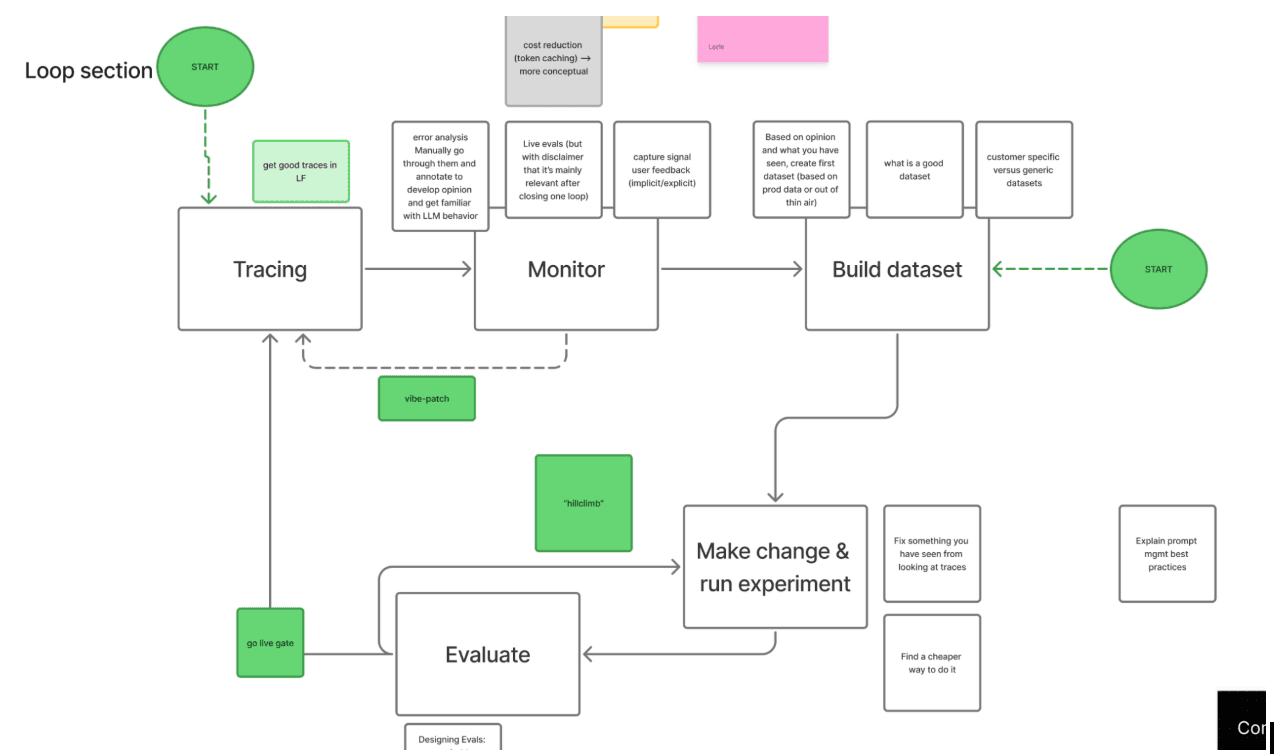
The loop below is a practical way to think about that work. It connects production visibility with structured improvement, so teams can move from "something feels off" to "we know what changed, why it changed, and whether it is better."
Read it as a loop
Start in production: tracing captures what happened, monitoring tells you what deserves attention, datasets turn recurring patterns into repeatable test cases, experiments isolate changes, and evaluation tells you whether the new version is actually better.
Once you ship a change, the cycle starts again. The updated system creates new traces, new monitoring signals, and new opportunities to improve.
From production signals to better systems
1. Tracing
Capture the full path of a request, including prompts, retrieved context, tool calls, outputs, latency, and cost.
2. Monitoring
Track how the system behaves over time and surface the traces that deserve attention.
3. Building datasets
Turn real scenarios into repeatable test cases so you can measure whether a change helps across more than a few examples.
4. Experimenting
Change one variable at a time, compare it against a stable baseline, and learn what actually improved.
5. Evaluating
Decide whether results are good enough to ship using manual review, code-based checks, or LLM judges.
What teams are balancing
Across the loop, teams are balancing output quality, latency, and cost. The goal is to make those tradeoffs explicit and grounded in evidence from your own application.